New Blog Series 🧠 The Human Cost of Systems


Schools, organisations, and institutions do not function because of policies, frameworks, inspection criteria, or strategic plans alone.


They function because of people.

- People who lead.
- People who teach.
- People who support.
- People who advocate.
- People who carry responsibility long after official working hours have ended.


Over the course of my career, I have worked across middle leadership, school improvement, SEND, EAL, assessment, inspection, and national strategy. I have helped build departments, systems, processes, and programmes designed to improve outcomes for others.


Along the way, I have noticed something.


We spend a great deal of time discussing systems.


Far less time discussing what those systems ask of the people inside them.

- The emotional labour.

- The ethical dilemmas.

- The identity shifts.

- The grief.

- The loyalty.

- The boundaries.

- The quiet courage required to hold professional standards when pressure pushes in another direction.


This series explores those often-unspoken experiences.


Not through the lens of blame or criticism, but through reflection, curiosity, and a belief that healthier institutions begin with a better understanding of the humans who sustain them.


Some posts will explore leadership.


Others will explore belonging, professional identity, moral pressure, institutional change, inclusion, accountability, and the emotional realities of working within complex systems.


Many of the themes emerge from education, but the experiences themselves are not unique to schools.


They belong to anyone who has ever cared deeply about a role, a profession, a community, or an institution.


If you have ever found yourself caught between competing responsibilities, questioning where professional judgement ends and institutional pressure begins, grieving the loss of a culture you once believed in, or trying to hold boundaries whilst still serving others well, this series is for you.


Because behind every framework, policy, strategy, inspection, intervention, and improvement plan, there are people.


And people carry more than systems often acknowledge.


Welcome to 🧠 The Human Cost of Systems.


Current Articles

  • The Quiet Grief of Professional Change: Institutional Grief and Finding Closure at the End of the Academic Year


Coming Soon

  • The Cost of Holding Boundaries: Professional Judgement, Moral Pressure, and the People Caught in the Middle
  • The Emergency Services Professional
  • Institutional Amnesia
  • Grieving the Profession You Entered


Reflective teacher in a historic school classroom overlooking end-of-year farewells on sports fields
by Jessie Joubert 27 May 2026
🧠 The Human Cost of Systems: A reflective exploration of institutional grief, professional identity, emotional labour, and finding closure at the end of the academic year. For educators, leaders, and professionals navigating change.
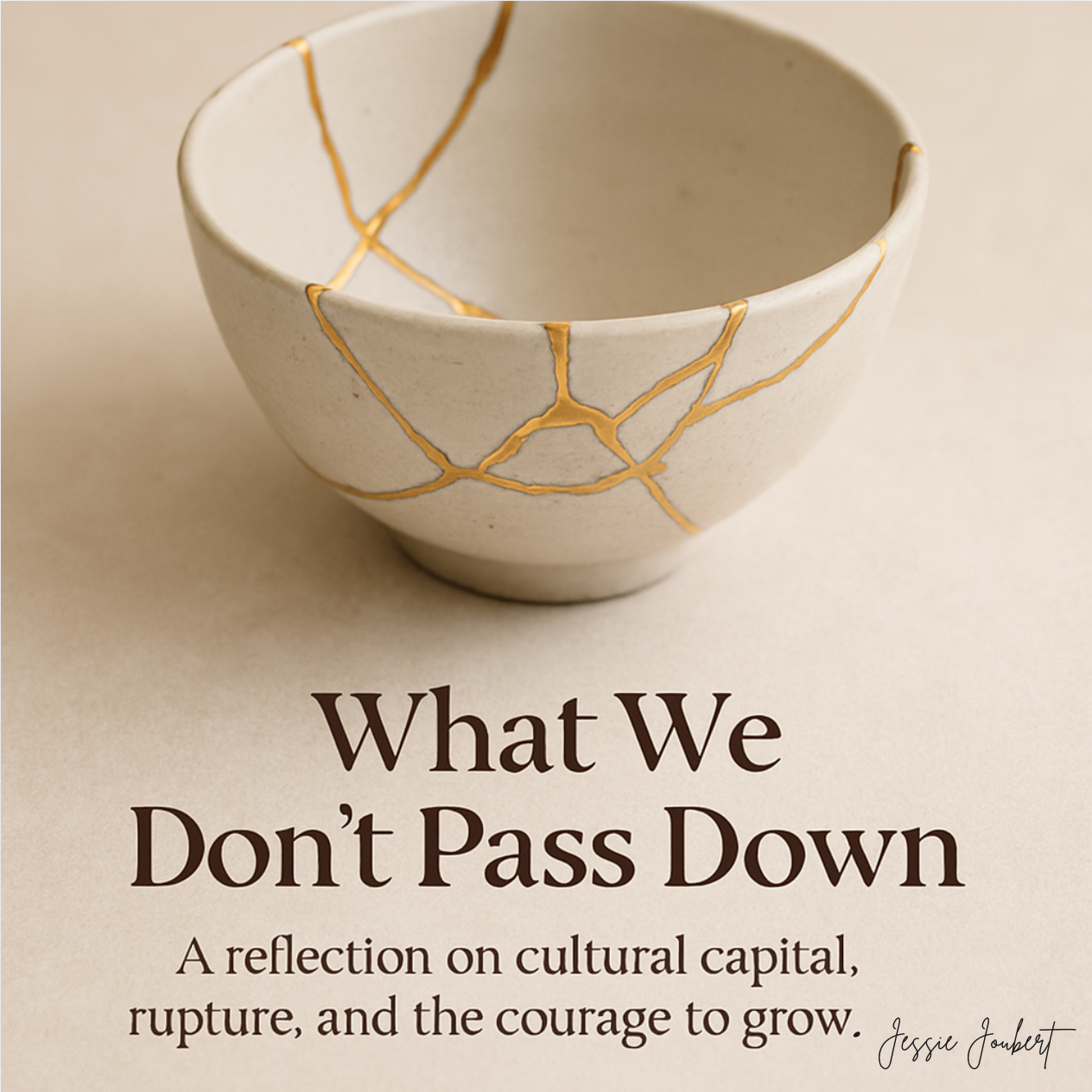
“What We Don’t Pass Down – A reflection on cultural capital, rupture, and the courage to grow.”
by Jessie Joubert 13 August 2025
👑 Cultural Capital, Post 4: A reflection on cultural capital, legacy, and the quiet power of letting go. What we break, heal, and grow differently — for ourselves and for others.
by Jessie Joubert 7 August 2025
👑 Cultural Capital, Post 3: A quiet reflection on how families pass down cultural capital — in stories, in silences, in choices. What we inherit. What we give. What schools might miss.
?️
by Jessie Joubert 7 August 2025
🏙️ Lessons from the Field - Post 5: Joy and Kindness After weeks of inspections, travel and professional stretch, I’ve been reflecting on what matters most:Not just outcomes. But how we get there. The best schools I’ve seen this year were clear, rigorous… and kind. Kindness is a strategic choice.
by Jessie Joubert 5 May 2025
What does it really mean for a school to be “ready”? This post explores the difference between readiness and polish—why inspection preparation isn't about perfection, but about shared direction, transparency, and professional trust. I’ve included a simple 2025/26 readiness checklist for leaders thinking ahead, and a reminder: ✨ Good schools aren’t perfect. They’re honest. #schoolleadership #inspection #strategicplanning #culturalcapital #beautifulbrain #LessonsFromTheField
by Jessie Joubert 30 April 2025
🏙️ Lessons from the Field – Post 2: Dubai 4100 students. 1 school. What I saw was not scale at the expense of humanity—but scale in service of it. A community of care held together by brilliant logistics, focused leadership and systems that breathe. Size wasn’t the challenge. Design was the answer. 💡 Read the full reflection here: [Insert URL once live] #education #schoolleadership #internationaleducation #culturalcapital #beautifulbrain #inspection
This small school didn’t wait for a roadmap. They built their path through...
by Jessie Joubert 30 April 2025
🏙️ Lessons from the Field – Post 1: Romania In the first blog of the Lessons from the Field series, I reflect on what it means to grow without a script—and how real leadership often begins in uncharted territory. #education #leadership #schoolimprovement #culturalcapital #beautifulbrain #inspection.
After two intense inspections across two countries...
by Jessie Joubert 28 April 2025
🏙️ Lessons from the Field – Post 3: Rest makes reflection possible. This post is about what happens between the big things. The rest, the reset, and the quiet clarity that only comes when the noise pauses. #teacherwellbeing #educationleadership #schoolculture #rest #reflection #beautifulbrain
by Jessie Joubert 3 April 2025
👑 Cultural Capital, Post 2: What we carry to work... A quiet reflection on what we carry into our work — and how rethinking behaviour, belonging and cultural capital might help us see more, not assume more.
by Jessie Joubert 24 March 2025
In this first post, we open the doors to Beautiful Brain — a creative, critical space for reflecting on education, inclusion, and innovation. Meet the mind behind the blog, explore the purpose of reflective practice, and discover how sharing small thoughts can lead to big ideas.

Why we must build, not assume, cultural capital — and how it opens doors to equity, dignity and belonging.

Cultural capital isn't just a buzzword — it's a gateway. In this piece, I reflect on how schools can broaden opportunity by recognising the hidden assets learners bring and rethinking the assumptions that too often close doors. Drawing from theory, practice, and lived experience, I explore how cultural capital intersects with inclusion, early intervention, and social justice — and why we must build it early, equitably, and with care.

Cultural capital plays a quiet but powerful role in shaping learners' outcomes. Too often misunderstood as an elitist concept, it actually holds the key to unlocking opportunity—if we reframe it inclusively, and act early.

What Is Cultural Capital, Really?

French sociologist Pierre Bourdieu defined cultural capital as the knowledge, skills, behaviours, and experiences individuals possess that confer advantage in society. While often reduced in schools to content knowledge or enrichment, cultural capital is far more layered—it includes familiarity, fluency, and confidence within academic spaces.

Bourdieu identified three forms:


  • Embodied: Habits, language, mindset
  • Objectified: Books, tools, artefacts
  • I nstitutionalised: Qualifications and credentials

In schools, this can be seen in fluency with academic language, ability to ‘read the room’, or knowing how to ask for help. These are not inherent—they are shaped by experience and exposure.


Inequity by Assumption

Learners who arrive with these assets—often through privilege—are positioned for success. Those without may be misinterpreted as disengaged or disruptive.

Take Student X: a 13-year-old excluded multiple times before anyone explored his learning profile. His story, shared here, reveals the consequences of assumptions and the cost of delayed intervention. His internalised shame, misread behaviours, and lack of early support illustrate what happens when systems overlook cultural and cognitive gaps.

From Policy to Practice: Reframing the Role of Schools

Ofsted’s 2019 definition—“the essential knowledge children need to be educated citizens”—supports a broader, more inclusive view. Schools are not passive observers of inequality; they are active builders of cultural capital.

Strategies include:


  • Early exposure to experiences (texts, trips, speakers)
  • Celebrating home languages and lived knowledge
  • Scaffolded support for literacy and vocabulary gaps
  • Assistive technologies and inclusive pedagogy
  • Valuing neurodiverse strengths


SEND, Literacy, and Social Justice

The link between unmet SEND needs and exclusion is well-documented. Many learners enter alternative provision or the justice system before their needs are even identified. Literacy challenges—especially when undiagnosed—compound this issue.

The SEND Code of Practice and frameworks like Gateshead’s YOT SEND Protocol call for earlier identification, higher expectations, and tailored support. This isn’t just educational—it’s societal.


Critical Caution: Avoiding Cultural Tokenism

Efforts to build cultural capital must be critically informed . When left unchecked, they risk reinforcing dominant norms and marginalising difference.

Educators must ask:

  • Whose culture is valued?
  • How can we integrate, not replace?
  • Are we affirming identity or expecting assimilation?

As Yosso (2005) reminds us, cultural wealth lives in community knowledge, home languages, lived stories, and resilience.

Conclusion: From Enrichment to Equity

Cultural capital shapes more than attainment—it shapes belonging. It’s not something a child should have to arrive with; it’s something schools can actively nurture.

Early, inclusive investment in cultural capital is not a luxury. It’s an act of justice. When schools act intentionally, they don’t just raise standards—they raise each other.


Click for the full article and references


Reflective teacher in a historic school classroom overlooking end-of-year farewells on sports fields
by Jessie Joubert 27 May 2026
🧠 The Human Cost of Systems: A reflective exploration of institutional grief, professional identity, emotional labour, and finding closure at the end of the academic year. For educators, leaders, and professionals navigating change.
“What We Don’t Pass Down – A reflection on cultural capital, rupture, and the courage to grow.”
by Jessie Joubert 13 August 2025
👑 Cultural Capital, Post 4: A reflection on cultural capital, legacy, and the quiet power of letting go. What we break, heal, and grow differently — for ourselves and for others.
by Jessie Joubert 7 August 2025
👑 Cultural Capital, Post 3: A quiet reflection on how families pass down cultural capital — in stories, in silences, in choices. What we inherit. What we give. What schools might miss.
?️
by Jessie Joubert 7 August 2025
🏙️ Lessons from the Field - Post 5: Joy and Kindness After weeks of inspections, travel and professional stretch, I’ve been reflecting on what matters most:Not just outcomes. But how we get there. The best schools I’ve seen this year were clear, rigorous… and kind. Kindness is a strategic choice.
by Jessie Joubert 5 May 2025
What does it really mean for a school to be “ready”? This post explores the difference between readiness and polish—why inspection preparation isn't about perfection, but about shared direction, transparency, and professional trust. I’ve included a simple 2025/26 readiness checklist for leaders thinking ahead, and a reminder: ✨ Good schools aren’t perfect. They’re honest. #schoolleadership #inspection #strategicplanning #culturalcapital #beautifulbrain #LessonsFromTheField
by Jessie Joubert 30 April 2025
🏙️ Lessons from the Field – Post 2: Dubai 4100 students. 1 school. What I saw was not scale at the expense of humanity—but scale in service of it. A community of care held together by brilliant logistics, focused leadership and systems that breathe. Size wasn’t the challenge. Design was the answer. 💡 Read the full reflection here: [Insert URL once live] #education #schoolleadership #internationaleducation #culturalcapital #beautifulbrain #inspection
This small school didn’t wait for a roadmap. They built their path through...
by Jessie Joubert 30 April 2025
🏙️ Lessons from the Field – Post 1: Romania In the first blog of the Lessons from the Field series, I reflect on what it means to grow without a script—and how real leadership often begins in uncharted territory. #education #leadership #schoolimprovement #culturalcapital #beautifulbrain #inspection.
After two intense inspections across two countries...
by Jessie Joubert 28 April 2025
🏙️ Lessons from the Field – Post 3: Rest makes reflection possible. This post is about what happens between the big things. The rest, the reset, and the quiet clarity that only comes when the noise pauses. #teacherwellbeing #educationleadership #schoolculture #rest #reflection #beautifulbrain
by Jessie Joubert 3 April 2025
👑 Cultural Capital, Post 2: What we carry to work... A quiet reflection on what we carry into our work — and how rethinking behaviour, belonging and cultural capital might help us see more, not assume more.
by Jessie Joubert 24 March 2025
In this first post, we open the doors to Beautiful Brain — a creative, critical space for reflecting on education, inclusion, and innovation. Meet the mind behind the blog, explore the purpose of reflective practice, and discover how sharing small thoughts can lead to big ideas.